
There’s a concept borrowed from role-playing games called min-maxing. The idea is simple: you build your character by putting every point into stats that win fights — damage output, attack speed, critical hit rate — and cutting everything else to the minimum.
Charisma? Dump stat. Lore knowledge? Irrelevant. Backstory? You’re a marketer, not a novelist.
It works, technically. Your character becomes a finely tuned killing machine. It also becomes the most boring person at the table — incapable of charming a merchant, inspiring an ally, or doing anything that isn’t hitting something very hard.
…Does that sound familiar?
 Optimizing for the Wrong Boss
Look at how advertisers talk about their craft today. Conversations are all efficiency ratios, attribution models, and A/B tests. The dashboard is the strategy. Tools have become an obsession. If the numbers trend in the right direction, the work is considered good — full stop. Quest complete.
But here’s what gets quietly stripped out in the process: the why. Why does this brand exist? Why should a person care? Why would any human being, mid-scroll, actually stop and feel something?
High Damage. Wrong Target.
Min-maxing in advertising means you’ve optimised for the measurable at the expense of the meaningful. And the meaningful doesn’t always show up in your reporting suite.
 A team finds a headline format with 14% better CTR and rolls it out everywhere, and within months the brand sounds like a spreadsheet. Technically correct, emotionally inert, indistinguishable from its competitors. The optimisation worked. The brand quietly vanished. Nobody has ever told a friend to check out a brand because the CTR was exceptional.
This is exactly what min-maxing produces in RPGs too. Your max-damage warrior clears the dungeon in record time. Then someone asks him to negotiate a trade agreement, and he attacks the ambassador. High damage. Catastrophic outcome. Significant diplomatic incident.
Brands that only min-max for performance face the same fragility. They get extremely efficient at capturing existing demand (think: harvesting intent, converting the already-convinced). But they’ve lost the ability to create demand. To make someone want something they didn’t know they needed.
That’s not an optimisation problem. That’s a storytelling problem.
And, as any seasoned game master will tell you, charisma gets you further than you’d expect. It’s the soft skills that make the difference. Skills like reading the room, knowing the etiquette, etc. The warrior who ignored those skills finds this out at exactly the wrong moment.
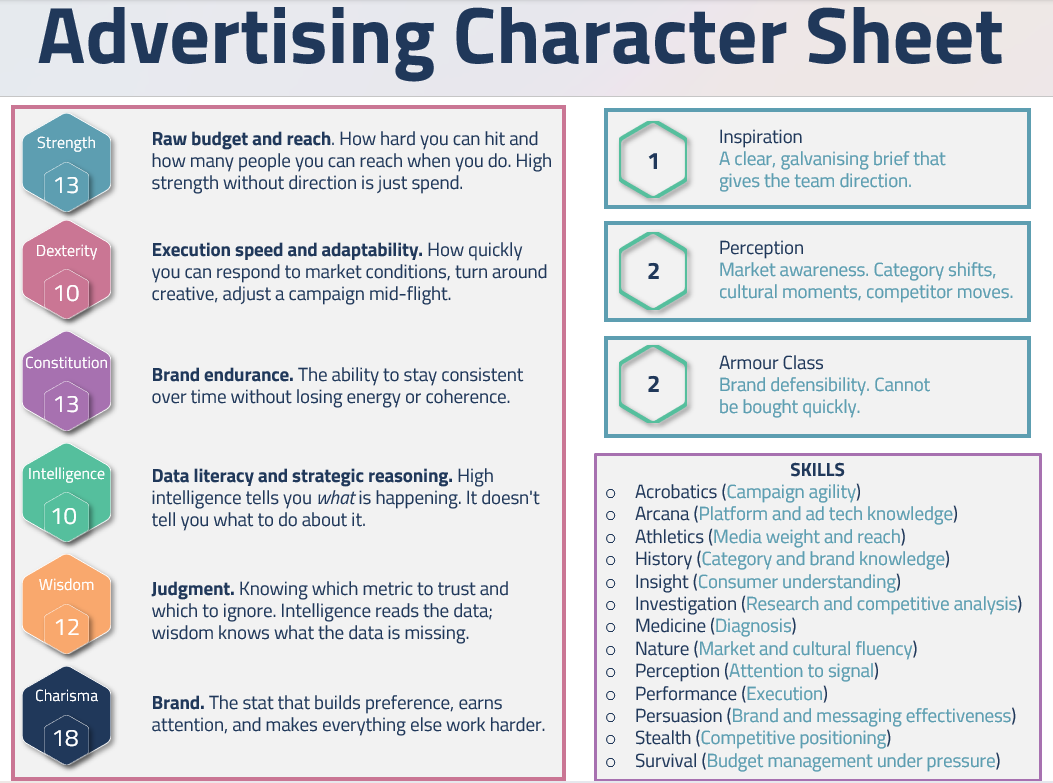
Well-Rounded Characters
The tools aren’t the villain here. Targeting, measurement, and media optimisation are genuinely valuable.
The mistake is treating them as the whole game rather than the equipment you bring to the game.
A legendary sword doesn’t tell you what you’re fighting for. It just makes you better at fighting. (Which is only useful if you’ve chosen the right battle.)
What advertising needs is those supposedly useless RPG stats: the charisma, the lore, the coherent backstory.
The things that don’t register on a performance dashboard but are precisely what make a brand worth paying attention to in the first place.
The Case for a Few Points in Charisma
In role-playing games, a balanced character isn’t someone who’s merely average at everything. (That’s just a different kind of disappointing.)
They know which stat matters most right now and can adapt when the situation changes.
They can fight when they need to. They can talk their way out when fighting would be stupid.
They’ve read enough lore to know what they’re dealing with before they attack it.
For advertisers, this means running performance activity and investing in brand, and developing the judgment to know which one the moment calls for. Efficiency is a multiplier. It needs something worth multiplying.
The min-maxed brand wins the quarter. The well-rounded brand wins the customer. Only one of those is a strategy.