
We talked about the Ad Frequency Onion before. We know how small exposures, repeated consistently, will shape outcomes.
When the grumpy, green ogre compared themselves to an onion, their donkey sidekick was quick to point out that parfaits also have layers, but have the benefit of being delicious.
It takes time, patience, and discipline to make an action occur, or change a mind.
When you do it right, you’ve got a delicious dessert. (Or breakfast. We don’t judge.)
This is where cumulative media effects theory comes in. It explains how media impact builds gradually through repeated exposure over time rather than an immediate response. It illustrates why ad frequency is one of the most important factors in a media strategy.
What Is Cumulative Effect Theory?
A single ad does not change behavior.
It’s not a ‘magic bullet’, as theorists in the 1930s through 1950s believed. Those early researchers believed media worked like a needle: once the message hit its target, the effect would be immediate.
But just like you receive a course of antibiotics from your doctor for a week, media requires multiple exposures to shape perceptions, norms, familiarity, and memory.
Repeated exposure to a message:
- Normalizes ideas
- Reinforces associations
- Reduces resistance
In this way, repeated messages shape what feels familiar or acceptable to an audience.
Why Frequency Is the Base Layer of Cumulative Impact

Repeated exposure triggers specific responses in the brain. Much like how neural pathways in the brain are strengthened by doing an action repeatedly, ad frequency:
o Reinforces memory
o Builds mental availability
o Increases fluency and trust
These factors help your message cut through an oversaturated media environment.
With so many messages being thrown at people all day, every day, one exposure isn’t going to cut it. You’re up against:
o Cognitive load: Audiences juggle too much for a single touchpoint to stick.
o Distraction: Competing demands pull attention away immediately.
o Competing messages: Brands fight for space in crowded environments.
By increasing your audience reach, you create an opportunity for your message to sink in. Frequency creates impact. It’s the memory insurance needed to stick the landing.
Passive Influence Is Still Influence
Did you know that many cumulative effects happen without active attention at all?
That’s right. Even being passively exposed to a message can influence you.
For example, watching movies or TV shows in a language you are learning can help increase your comprehension.
But passive exposure lays the mental framework future messages build on. It’s like reading the recipe before diving into baking a complex dessert.
Passive exposure will:
- Build familiarity
- Shape expectations
- Influence later decisions

Media planning must account for these passive moments, because that’s how people live. They watch the pre-roll ad before their online video. They drive by the same billboard on their way to the gym.
There are smart frequency principles to follow:
- Consistent presence across time
- Varying formats and environments
- Clear, repeatable brand signals
Each exposure adds a layer of influence, not a duplicate impression.
What’s the Sweet Spot?
 We’ve established that audiences need to see ads more than once to build memory. But it’s possible to go too far and show them your message so many times that it annoys them.
So, what’s the sweet spot? Is there a magic number to aim for?
Show it too little, and they forget you.
Show it too much, and they get annoyed.
There are too many variables to account for to have a solid scientific number. Younger audience or older? Behaviour change or selling? Social feed or billboards?
Everyone’s perfect parfait has different ingredients.
It’s best to think about this generally, as a guiding principle. While we know the historical marketing funnel is nonsense, it can help us conceptualize an approach here, for frequency.
Audiences near the ‘top’ of the funnel or early in their exposure, need more touches. Audiences near the ‘bottom’ of the funnel, who are already familiar, respond better to precise, lower-frequency exposure.
This chart from Meta helps visualize and give direction on how to approach planning frequency:
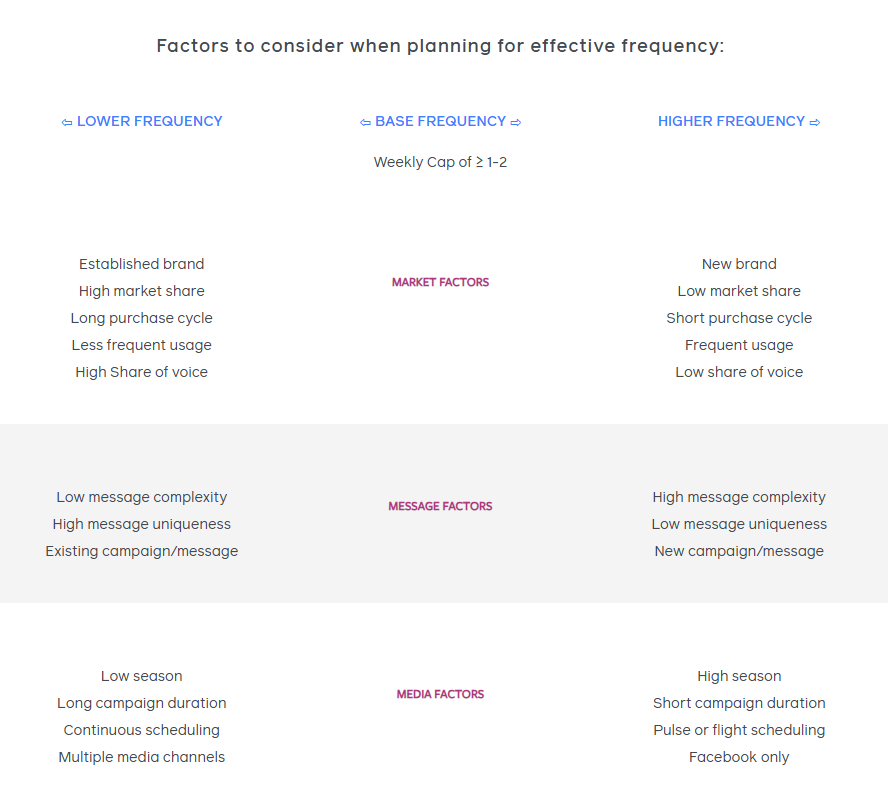
Frequency Factors
Influence Is Built, Not Triggered

Marketing combines past, present, and future messages to shape behavior. It takes time, patience, and discipline to make an action occur, or change a mind.
Small, consistent exposures, repeated but not annoyingly, will shape outcomes. Frequency isn’t repetition, it’s reinforcement. Each exposure builds on the last. It creates memory.
At Mediology, we plan for the long game — where familiarity becomes preference and preference becomes growth.
Because brands aren’t built in moments. They’re built in layers.