
Digital marketing is full of misconceptions and many are rooted in the idea that digital is a direct response medium and that the path to action is simple and linear.
In reality, both statements are flawed, and that’s largely because the traditional marketing funnel is flawed. At best, it’s no longer accurate, and at worst, it never was.
(Which is awkward, considering how many decks it still appears in.)
Advertising can be highly effective but it’s less like shooting an arrow at a target and more like throwing a bouncy ball down a hallway – each touch point will hopefully move it along the journey, but it may hit an obstacle and bounce back or roll under a door and disappear entirely.
And nowhere does that outdated thinking show up more clearly than our relationship with clicks. Which, outside of search, is a metric that doesn’t correlate with anything marketers actually desire, but is often the primary focus of digital reporting and optimizations.
Marketing and Quantum Physics Have a Measurement Problem
A click happened, or it didn’t.
In a world full of “maybe” and “sometimes,” the certainty of clicks feel comforting. Binary. Concrete. Easy to point to in a report. But as we know, just because something is easy to measure doesn’t make it meaningful.
When the first banner ad appeared in October 1994, with the epic copy, “Have you ever clicked your mouse right here? You will.” it changed advertising forever. For the first time, marketers had a visible action tied to exposure. A signal from consumers. Proof of marketing working.

Or at least proof of something happening..
The thing is, clicks measure clicks. They don’t measure intent, persuasion, or memory. They never have. But they were easy. And because they were first real measurement, they stuck around in the collective consciousness.
That was more than 30 years ago. Since then, we’ve dramatically improved how we understand human behavior, attribution, and media influence. Yet clicks still dominate how digital performance is judged.
Why? Because they feel objective.
Nothing calms a nervous stakeholder like a nice, clean percentage.
A click is a tap. Influence is something else entirely.
Marketing isn’t the only area with this measurement problem. Quantum physicists have the same issues.
Schrödinger’s Click: What Are We Actually Measuring?
In the classic quantum physics thought experiment, Schrödinger’s cat is in a box, and exists in two states at once — alive and dead — until the box is opened and the cat is observed.
Clicks work the same way.
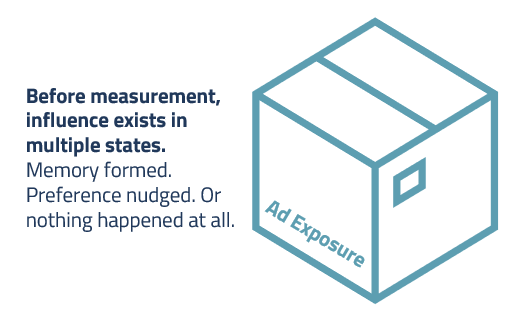
Before measurement, an ad exists in multiple possible states:
- It may have influenced memory
- It may have shaped future preference
- It may have nudged consideration
- Or it may have done nothing at all
All of those outcomes coexist.
The moment we optimize around clicks, we “open the box.” We collapse all those possibilities into a single observable outcome: click or no click.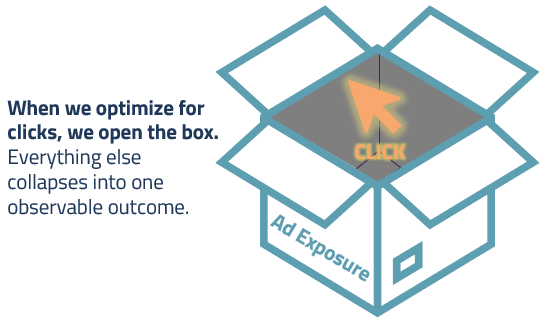
If there’s no click, we assume nothing happened.
But influence doesn’t disappear just because it wasn’t observed in that way.
A non-clicking ad isn’t “dead.”
It’s simply unmeasured. Or, measured by the wrong metric.
The Origin Story: What Clicks Were Actually Built For
Clicks were built to solve a narrow problem: navigation in an intent-driven environment.
The click was how users moved from one place to another. In the context of early digital advertising, especially search, a click was a clear signal: “I want to go there.”
Clicks are good at measuring one thing extremely well: immediate, observable action in response to a prompt.
Specifically, clicks are effective when:
- The user is already motivated
- The environment supports interruption
- The action is the goal, not a byproduct
Search advertising is built around this logic. When someone types a query, they are actively expressing a need, question, or desire. In that moment, clicking is not disruptive. The click is the point. Clicks worked because behavior and mindset aligned. That alignment does not exist everywhere else.
A research paper from 2018 dived into search behaviors, providing insights on user mindset and click behaviour:
- Target finding: focused searches,
- Users click on top results only
- Decision making: shorter queries,
- Browse deeper into results, click on more results
- Exploration: the most queries
- Browse deep, but not as many clicks
In the environment of search, ecommerce, or performance marketing, click-through rate can be a useful proxy for success.
Clicks weren’t built to answer the question: “Did this advertising work?”
They were built to answer: “Did someone choose to go there?”
Those are very different questions.
Where It Went Wrong: Applying Click Logic Everywhere
Outside of search or ecommerce, clicks become a behavioral mismatch.
People scrolling social feeds aren’t asking to leave what they’re doing. People watching video want to keep watching video. In those moments, clicking is often accidental, disruptive, or simply unlikely.
Clicks don’t tell you whether the ad worked. They only tell you someone opened the box — possibly while trying to close the app, wipe a fingerprint, or recover from a scroll slip
And the data backs this up.
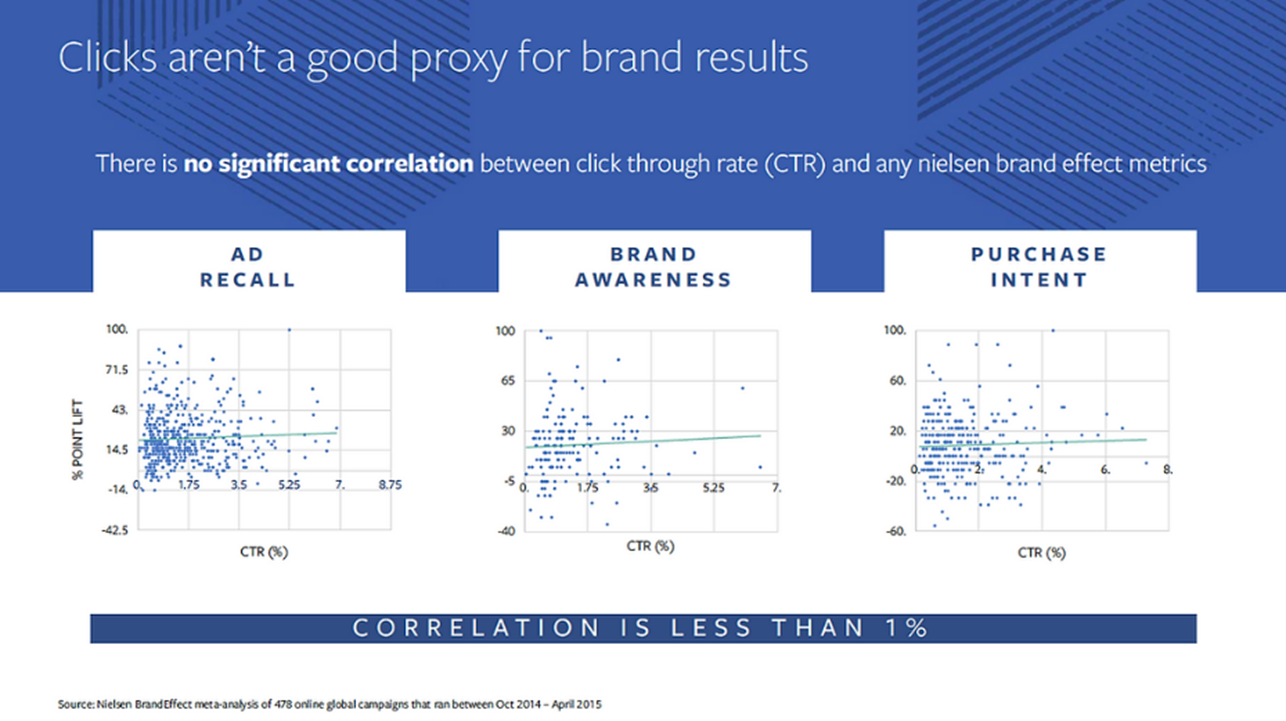
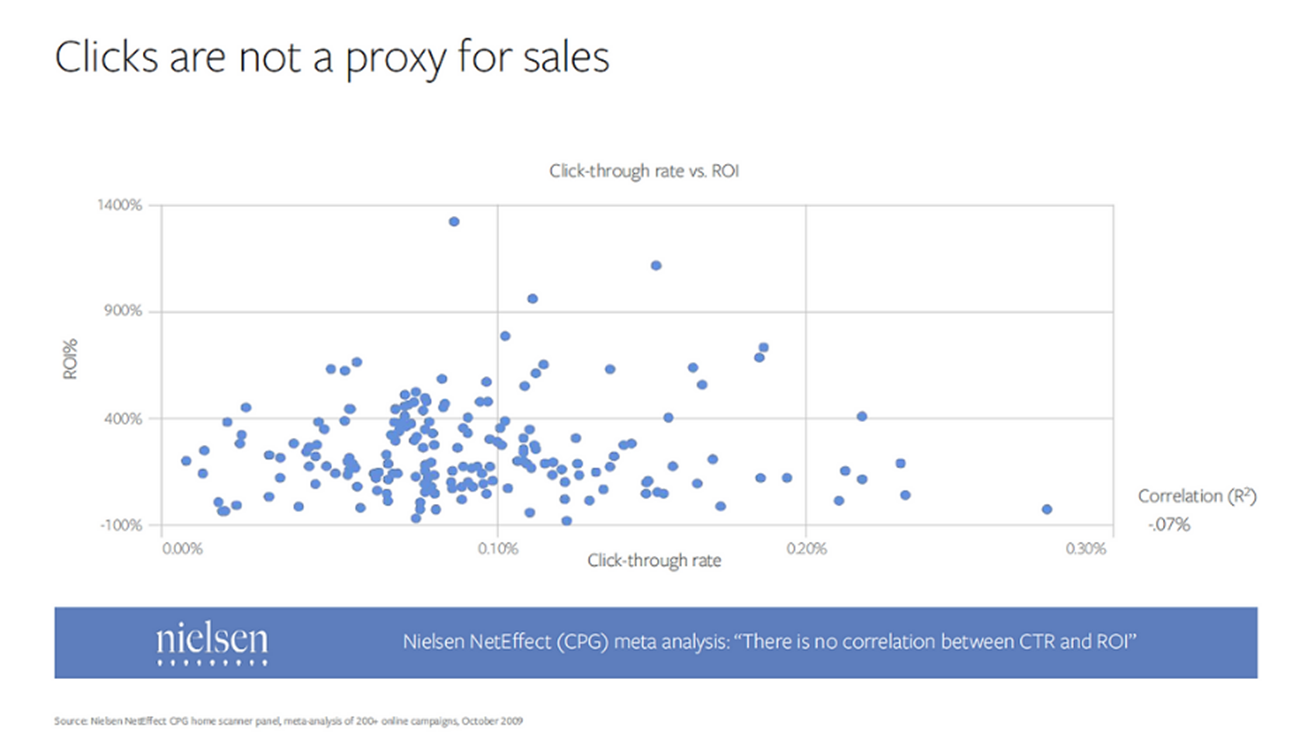
Studies from Facebook, Nielsen, comScore, and Quantcast, have shown little to no correlation between click-through rates and brand outcomes. Facebook’s internal platform research has shown that the majority of people who later purchase a product never clicked the ad that influenced them.
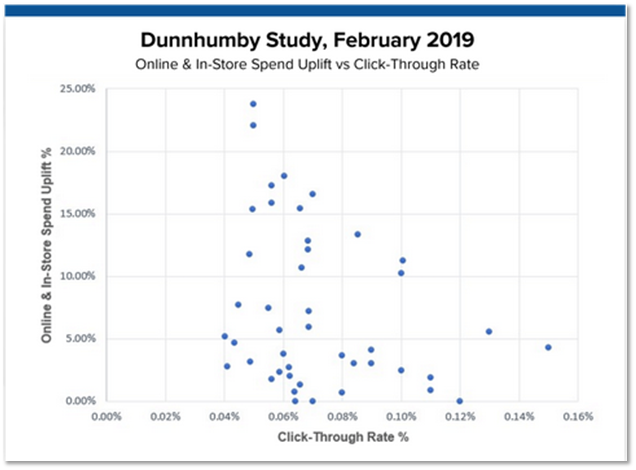
Source: Quantcast Don’t Be Ruled by the Click (2019)
A 2021 eMarketer study found that more than half of U.S. adults said they were not at all likely to click on a digital ad, even when it was relevant. That doesn’t mean the ad failed. It means people were busy doing what they came there to do. Radical.
Clicks didn’t capture the influence. They failed to observe it.
Non-clicking is not the same as ignoring.
The Clicky Audience Problem
When platforms optimize toward clicks, they don’t find better customers. They find clickers.
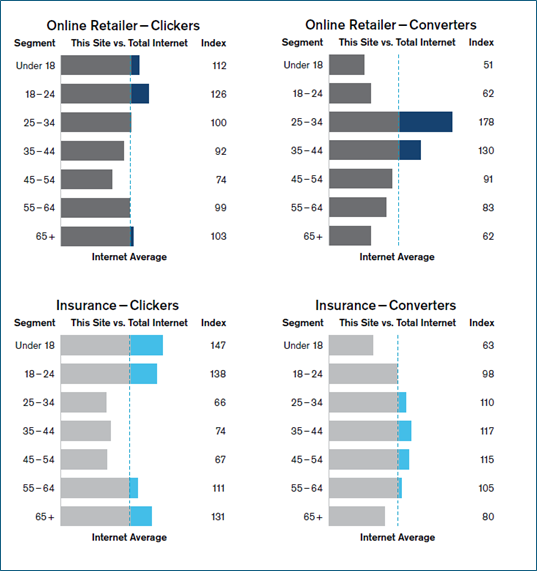
Source: Quantcast “Display Ad Clickers are Not Your Customers”
Way back in 2009, media measurement company comScore and Starcom USA published “Natural Born Clickers”, showing that
- 85% of display clicks came from only 8% of internet users
- the number of people that click ads had decreased to 16%
Marketers are neglecting the other 84% of their audience when optimizing to click activity.
Then in 2013, technology company Quantcast released a white paper labeled “Display Ad Clickers are Not Your Customers” and showed that the audience profile of a clicker very different from a converter.
They also highlighted a case study where 99% of attributed conversions came from people who did not click the display ads (view-through conversions).
More recently, data from 2021 was used by Quantcast to continue to show that clicks and converters are not the same audience.
Focusing on clickers leads to predictable outcomes:
- Smaller relevant reach
- Higher cost-per-thousands
- Audiences that look active but don’t convert
You’re not optimizing for influence, you’re optimizing for observable behavior. Schrödinger’s Click strikes again: only the visible state is rewarded, even if it’s not the valuable one.
Why CTR Refuses to Die
So why does this persist, despite decades of evidence?
Because clicks are:
- Easy to collect
- Easy to automate
- Easy to optimize
They feed algorithms cleanly. They look impressive in dashboards. And they serve platform success narratives more obviously than true advertiser outcomes.
Clicks are often a platform performance indicator masquerading as a business performance indicator. And the disguise is surprisingly convincing.
They reward environments where interaction is easiest, not where influence is strongest.
The False Promise of Engagement
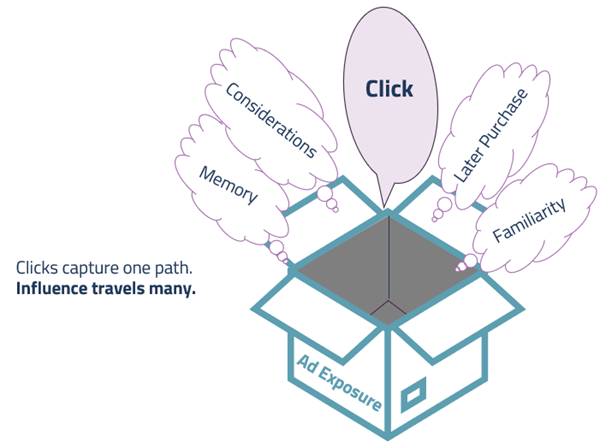
Clicks, likes, shares, and completion rates all suffer from the same limitation: they are selective. They capture a sliver of behavior and present it as the whole story.
Real advertising impact is cumulative. It’s built through repeated exposure, emotional resonance, and memory. Often without measurable interaction at all.
Just because the box wasn’t opened doesn’t mean nothing happened inside.
So What Should We Measure Instead?
Clicks aren’t useless. They’re just limited.
They work best in direct-response environments like search. They don’t work as universal proof of effectiveness.
Better questions lead to better measurement:
- Did we reach enough of the right people?
- Did we show up often enough to be remembered?
- Did behavior change later, even without interaction?
Metrics like reach, frequency, brand lift, view-through conversions, recall, and long-term sales trends tell a more complete story.
For performance campaigns, that can be conversion focused metrics like cost per acquisition or return on ad spend.
For awareness campaigns, that may be volume of viewable impressions and frequency against an audience.
Media should be judged by overall influence, not in-the-moment reflexive behavior.
Clicks Aren’t Dead: They’re Just Overhyped
 If clicks truly measured effectiveness, pop-ups would be the greatest advertising innovation of all time. CAPTCHAs would be conversion gold.
They aren’t.
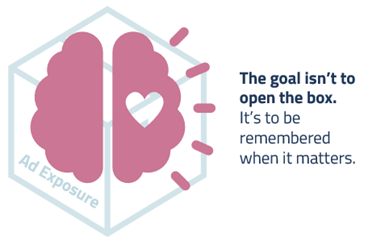
Media works because it shapes memory, familiarity, and preference long before action occurs. Clicks are a moment. Influence is a process.
The next time you evaluate performance, don’t just ask if the box was opened.
Ask whether the brand survived long enough to matter*.
(*No dashboards were harmed in this thought experiment.)