

The ‘Marketing Funnel’. If you look closely, it’s less a funnel these days, and more of a pretzel. And I do love pretzels.
The ‘funnel’ has been twisted, looped, reshaped by human behaviour, and stretched across too many channels. It was never meant to be this complicated.
So, is it still valuable for media planning? Or have we baked it beyond recognition?
The Funnel Was Built for Doorbells, Not Digital

In the early 1900s, salespeople needed a way to structure a short, persuasive pitch at the doorstep. From awareness to action in a few minutes flat. That’s where the funnel came in.
Fast forward a century, and we’ve twisted that simple idea into a pretzel trying to account for every possible click, scroll, and swipe. We keep twisting the same dough instead of baking something new.
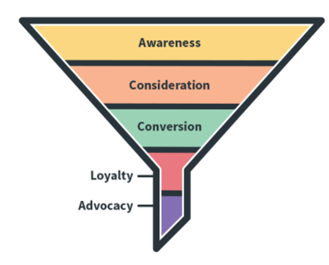
Image: https://sproutsocial.com/glossary/marketing-funnel/
While there are a number of different variations of the funnel, the three consistent sections are:
Top
- Awareness, Consideration
- This is where reach matters.
- Broad audiences, educational content, and storytelling that opens the door.
- KPIs here focus on visibility: impressions, frequency, and engagement.
Middle
- Conversion
- Now we hook. We identify who’s leaning in and why.
- KPIs shift to actions — time on site, sign-ups, purchases, behavioural shifts. This is where intent starts to show.
Bottom
- Loyalty, Advocacy
- The relationship deepens. We move from transaction to trust.
- KPIs here reflect retention, repeat behaviour, and brand advocacy.
The Problem with the Funnel
The marketing funnel was never meant to carry this much weight.
Originally, it was built for a single moment — one person, one pitch, one sale. A simple structure for guiding someone from awareness to action in the space of a doorstep conversation.
Today, we’ve stretched that model across platforms, audiences, and timelines. We assume people are always somewhere in the funnel: considering, evaluating, buying, or buying again.
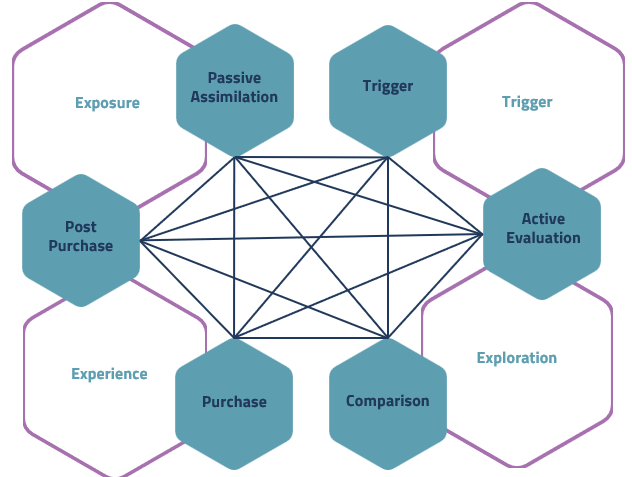
That assumption creates problems. It’s deliciously complex, but hard to follow, like trying to trace a multi-loop pretzel without losing track. Campaigns become fragmented. Budgets get spread thin. Messages lose clarity. And most importantly, it ignores how people actually behave.
They’re not thinking about your brand. They’re thinking about lunch. Or school pickup. Or their next meeting. Or as Ethan Decker at Applied Brand Science shared, they are living.
That’s why mental availability matters more than funnel stages. Not a constant presence, but instead a timely presence. Being top of mind when the moment finally arrives.
Somewhere in all the loops and layers, we lost sight of something simpler: memory.
The Missing Layer: Mental Availability
The marketing funnel has long been the default framework for guiding audiences from awareness to action. But it rarely highlights a concept that’s arguably more important: mental availability.
Mental availability is the likelihood that your brand comes to mind at the exact moment a decision is made. It’s not just about being seen. It’s about being remembered when it counts.
Think about your last trip to the grocery store. You walked past the bread aisle. You didn’t compare ingredients or packaging. You reached for the brand you always buy. That’s mental availability in action. Your brain retrieved a familiar choice at the right time, without conscious effort.
This is the real challenge for media planning today. People aren’t constantly evaluating brands. Most of the time, they’re filtering out marketing altogether.
That’s why building memory matters more than chasing constant engagement. The moment that matters might come weeks, even months, after someone sees your ad. And when it does, your brand needs to be the one they recall.
“We should be thinking of (marketing) as … nudging people’s purchase behaviours, keeping our brand in their repertoires, or nudging it into people’s repertoires,” as Martin Weigel puts it.
Mental availability isn’t just about what people think of you. It’s about nudging them, so when they do think, they think of you.
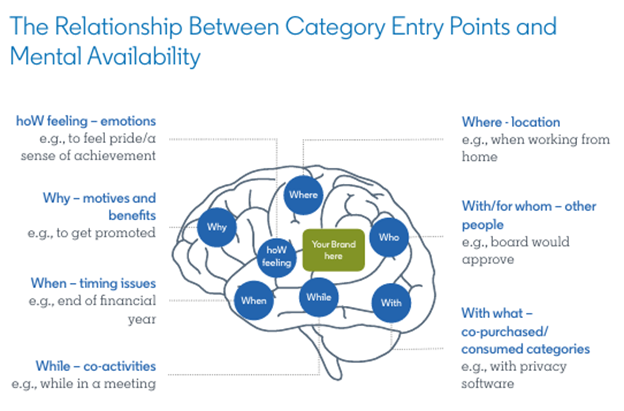
Source: How Salesforce’s Trailblazer Campaign Builds Mental Availability A Case Study By The B2B Institute
Turning Pretzel Logic into Real Strategy
The funnel might have become a pretzel, but it’s still made of the same dough: attention, emotion, and memory.
To win attention and recall in a noisy world, brands need to plan for memory, not just impressions. Here’s how to play the long game:

REACH: Be present and consistent to the widest set of your audience
- Go broad, not narrow: Balance precise targeting with broad reach to stay accessible across buying occasions — not just to those “in-market” now.
- Show up often and everywhere: Use consistent, multi-channel presence (digital, video, audio, OOH, social) to ensure your brand feels familiar when decisions happen.

MESSAGE: Interesting and Relevant message
- Connect emotionally, not just functionally: Mental availability grows when your message triggers feeling — curiosity, humor, belonging — not just product recall.
- Be context-aware: Adapt creative and tone to the environment and audience mindset while keeping your core message consistent across touchpoints.

BRAND: use your distinct brand assets to build recall
- Leverage your assets consistently: Use recognizable colors, sounds, taglines, logos, and spokespersons as memory shortcuts to your brand.
- Refresh, don’t reinvent: Evolve your assets with care — subtle modernizations can strengthen recognition without losing the cues your audience already connects with.
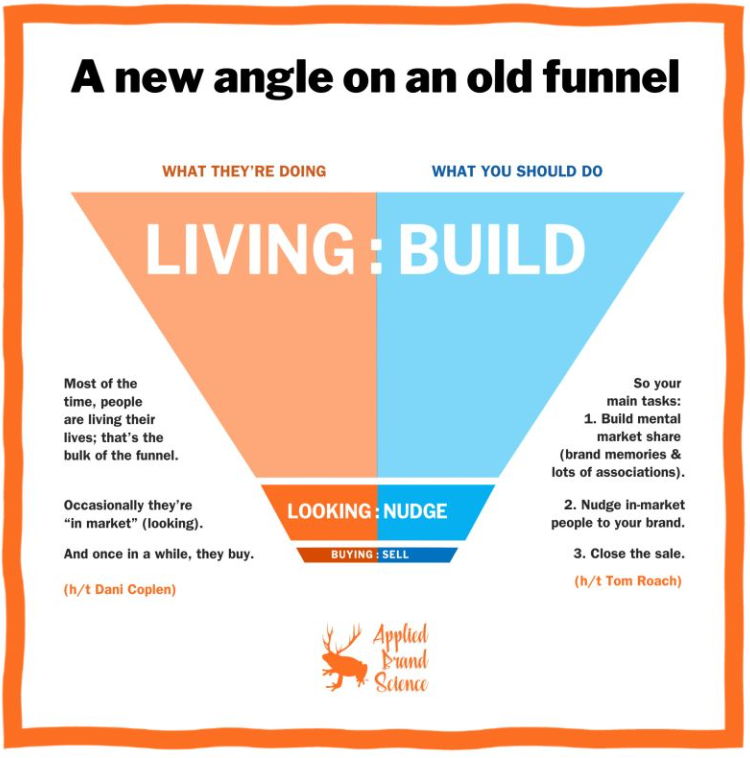

Funnels help visualize stages and map the journey, but memory fuels momentum.
Real conversion comes from reaching enough of the right people, with enough consistency, to be remembered when it counts.
That’s the role of media: not just to optimize numbers, but to influence people.
So the next time you build a campaign, don’t focus on baking the perfect pretzel. Make sure people take a bite, and remember the taste when it matters most.